Showing posts with label hague. Show all posts

Monday, March 6, 2017

Adoption Notice – Poland Restructure of International Adoption Process

unnamedDear Adoption Community,

Adoption Notice: Poland – Restructure of international adoption process on March 6, 2017

“The Government of Poland is revising its policies on intercountry adoptions under the Hague Adoption Convention. Poland has indicated its intent to prioritize domestic adoptions, except in the case of intercountry adoptions of siblings related to children already adopted through intercountry adoption, intrafamily adoptions, and adoptions by Polish citizens living abroad. It is unclear how these intended changes will impact intercountry adoptions from Poland sought by U.S. citizen families that are already in process, but in cases in which referrals have not yet been received, parents may see extended delays. The actual impact and form of these changes is still to be determined, and we will continue to update this page as more information becomes available.”

Friday, March 3, 2017

Adoption Notice – Adoptions from Ghana after March 2, 2017

On January 1, 2017, the Hague Convention on Protection of Children and Co-Operation in Respect of Intercountry Adoption (Convention) entered into force for Ghana. After reviewing Ghana’s Amended Children’s Act of 2016, and confirming the establishment of Ghana’s Central Authority, the United States has determined that it will now be able to issue Hague Adoption Certificates for adoptions from Ghana. Consular officers will verify on a case-by-case basis that an intercountry adoption can proceed in accordance with the Convention, as well as with U.S. laws and U.S. obligations.

The Department of State cautions U.S. prospective adoptive parents that there may be delays in the adoption process while Ghana works to implement its new adoption laws, regulations, and procedures. Prospective adoptive parents initiating an intercountry adoption on or after January 1, 2017, should work closely with their U.S. accredited adoption service provider (ASP) to ensure they complete all necessary steps under Ghana’s adoption process in accordance with Ghanaian and U.S. laws.  

Continue reading.

Tuesday, October 25, 2016

USCIS Fee for Certificate of Citizenship Will Increase on December 23, 2016

Fee Changes from USCIS Hague and Non-Hague Petitions and Certificate of Citizenship

Image2

On Monday October 24, USCIS published its final rule outlining changes in their fee schedule for services, including those for several adoption-related services.  You will note small fee increases for I-600/600As, I-800/800As, and a near-doubling of the fee to obtain a certificate of citizenship (N-600), which increases to $1,170.  The fee increases go to into effect on December 23, 2016. If you are filing any adoption related petition, be sure to reference the new fee schedule.  All this is very disappointing given the broadly expressed opposition to increasing the N-600 and that Congress even made their objections known.
 
Click here for more information.

Thursday, July 2, 2015

Part II: Article on non-convention adoptions/guardian pitfalls and perils

Avoiding the Perils and Pitfalls of Intercountry Adoption from Non-Hague Countries: Considerations for Agencies and Adoptive Parents (Part II)

Source: http://www.adoptioncouncil.org

By: Christine Lockhart Poarch and J. McLane Layton

Introduction

This is Part II of a two-part series that provides an overview of the most common perils and pitfalls involved in designating a child as an orphan under U.S. law, and emphasizes best practices for agencies and adoptive families when pursuing adoptions in countries that are not signatories to The Hague Convention on the Protection of Children and Co-operation in Respect of Intercountry Adoption. Part I provided a complete and thorough explanation of the orphan definition under U.S. law. Part II provides an overview of the procedural requirements and potential practical complexities in orphan cases.

Read more.

Friday, March 21, 2014

Foreign Adoptions by Americans Decline Sharply

NEW YORK March 21, 2014 (AP)

By DAVID CRARY AP National Writer
Children%20in%20Families%20First%202014

The number of foreign children adopted by U.S. parents plunged by 18 percent last year to the lowest level since 1992, due in part to Russia's ban on adoptions by Americans. Adoptions from South Korea and Ethiopia also dropped sharply.

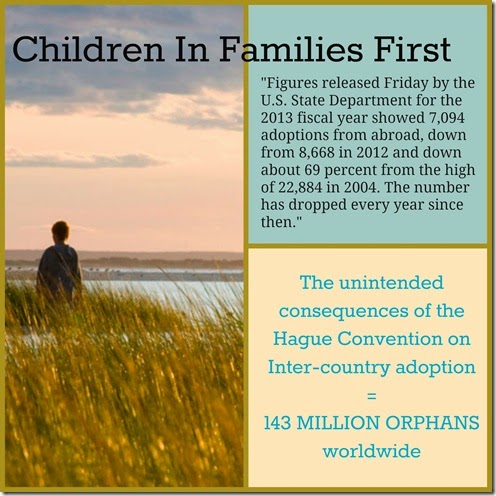
Figures released Friday by the U.S. State Department for the 2013 fiscal year showed 7,094 adoptions from abroad, down from 8,668 in 2012 and down about 69 percent from the high of 22,884 in 2004. The number has dropped every year since then.

As usual, China accounted for the most children adopted in the U.S. But its total of 2,306 was far below the peak of 7,903 in 2005.

Ethiopia was second at 993, a marked decline from 1,568 adoptions in 2012. Ethiopian authorities have been trying to place more abandoned children with relatives or foster families, and have intensified scrutiny of orphanages to ensure that children placed for adoption are not part of any improper scheme.

Russia had been No. 3 on the list in 2012, with 748 of its children adopted by Americans. But that number dropped to 250 for 2013, representing adoptions completed before Russia's ban took effect.

The ban served as retaliation for a U.S. law targeting alleged Russian human-rights violators. It also reflected resentment over the 60,000 Russian children adopted by Americans in the past two decades, about 20 of whom died from abuse, neglect or other causes while in the care of their adoptive parents.

Moving into the No. 3 spot for 2013 was Ukraine, currently engaged in political conflict with Russia. Ukraine accounted for 438 adoptions, followed by Haiti with 388, Congo with 313 and Uganda with 276.

Despite the relatively high numbers of adoptions from the Congo, that African country has been the cause of heartache from some American families trying to adopt Congolese children. In several instances, U.S. parents have obtained court approval for adoptions and taken custody of the children, only to be denied exit permits that would enable them to bring the children to the United States. They face a choice of living in the Congo with their children or returning to the U.S. without them.

"It's a terrible shame," said Susan Jacobs, the State Department's special adviser on children's issues.

Along with Russia and Ethiopia, the biggest contributor to the one-year drop was South Korea, which accounted for 627 U.S. adoptions in 2012 but only 138 last year. Jacobs said this decline was due primarily to new adoption procedures implemented by South Korea.

The last time there were fewer foreign adoptions to the U.S. was in 1992, when there were 6,472, and the downward trend has dismayed many advocates of international adoption.

Chuck Johnson, CEO of the National Council of Adoption, contended that the decline stems in part from the way the State Department has applied the Hague Convention on Inter-Country Adoption, which establishes ethical standards for international adoptions.

The U.S. entered into the agreement in 2008 with strong support from adoption advocates who hoped it would curtail fraud and corruption, and then lead to a boom in legitimate adoptions. Instead, the decrease has continued.

"The U.S. has encouraged and in some cases strong-armed impoverished countries to sign the Hague Convention and then cites their inability to comply with strict Hague standards as a reason for not doing intercountry adoption with them," Johnson said.

Johnson expressed hope that Congress would support a bill introduced with bipartisan support last year — the Children in Families First Act — that would encourage more adoptions of foreign orphans. It would create a new bureau in the State Department assigned to work with non-governmental organizations and foreign countries to minimize the number of children without families — through family preservation and reunification, kinship care, and domestic and international adoption.

Concerns about corruption, child-trafficking and baby-selling have prompted the United States to suspend adoptions from several countries in recent years, including Vietnam, Cambodia, Guatemala and Nepal.

However, Jacobs said some adoptions from Vietnam — mostly involving children with special needs — were expected to resume soon. She said a Vietnamese delegation was due in the U.S. next month to interview U.S. adoption agencies with the aim of selecting some to operate in Vietnam.

"One thing that remains constant is our support for intercountry adoptions and our determination that they are done ethically and transparently," Jacobs said. "I can't think of anything worse than for a child to be consigned to an institution when they should be with a family."

The State Department reported that 84 American children were adopted by residents of foreign countries last year — 35 of them went to Canada and 38 to the Netherlands.

State Department: http://adoption.state.gov/about—us/statistics.php

David Crary can be reached at http://twitter.com/CraryAP

Saturday, June 8, 2013

Universal Accreditation Act Info: Important Information for Independent Adoption or Facilitator Supported Adoptions in Non-Hague Convention Countries

This set of FAQs addresses changes to intercountry adoption law and practice brought about by the Intercountry Adoption Universal Accreditation Act of 2012 (UAA). The President signed the UAA into law on January 14, 2013. The new law takes effect 18 months thereafter on July 14, 2014.

Read more.

Tuesday, May 14, 2013

Ghana Adoption Alert

th The Dept of State, Office of Children’s Issues has issued the following alert regarding adoptions from Ghana. Issued May 13, 2013.

The Government of Ghana has temporarily suspended processing of all adoption cases, including intercountry adoptions, pending Ghana’s review of its current adoption procedures. The U.S. Embassy in Accra is seeking further clarification of the scope and duration of this temporary suspension by the Government of Ghana and how this suspension may effect pending adoptions.  The U.S. Embassy will continue processing adoption cases already approved by Ghanaian authorities.  The Department of State will continue providing updated information on adoption.state.gov as it becomes available.  If you have any questions about this notice, please contact the Office of Children’s Issues at 1-888-407-4747 within the United States, or 202-501-4444 from outside the United States.  Email inquiries may be directed to AdoptionUSCA@state.gov.

Hopscotch is suspending acceptance of *new* applications until further directed by the Department of State.  All cases with court decrees issued at the time of the alert will continue to be processed by the US Embassy in Accra. 

Hopscotch supports the temporary suspension, which allows the Ghanaian government to reorganize their adoption processes, ensuring all children are receiving protection and ethical services.  Hopscotch continues to advocate for ethical and legal adoption procedures and practices. 

In advance preparation of Universal Accreditation Act, set to be implemented in July 2014, non-Hague Convention countries' are demonstrating a serious commitment to child protection and working only with US licensed and Hague accredited adoption service providers.

Wednesday, April 11, 2012

Romania New Adoption Law in Effect

April 10, 2012 | adoption.state.gov

The Romanian Office for Adoptions announced that its new adoption law went into effect on April 7, 2012.  The new law allows for intercountry adoptions of Romanian children by relatives of the fourth degree of kinship, the spouse of the child’s natural parent, and Romanian citizens who are habitually resident abroad.

Please be aware that the U.S. law implementing the Hague Convention on Protection of Children and Co-operation in Respect of Intercountry Adoption (the Convention), the Intercountry Adoption Act of 2000 (IAA), requires prospective adoptive parents to be U.S. citizens in order to be eligible to apply for intercountry adoption using U.S. procedures.  This means that Romanian citizens legally residing in the United States will be able to adopt from Romania only if they or their spouses are also U.S. citizens.

Moreover, the U.S. Hague Adoption Convention accreditation regulations (22 CFR 96) provide that in each Convention adoption case, an accredited agency, a temporarily accredited agency, or an approved person will be identified and act as the primary provider.  More information on the role of U.S. accredited ASPs and the role of U.S. accrediting entities is available on the Department’s adoption website, adoption.state.gov.  

The Department of State has provided information to the Romanian Office for Adoption about the U.S. requirement for a primary provider to serve in each Convention adoption, explaining the critical monitoring and oversight role of U.S. accrediting entities in ensuring that ASPs remain in substantial compliance with the IAA and the Convention.  We look forward to the opportunity to expand our cooperation with Romania as Convention partner countries.

Tuesday, November 22, 2011

"Not Clearly Approvable" Defined

Consular officers at U.S. Embassies and Consulates have limited, delegated authority from the United States Citizen and Immigration Service to approve Form I-600 petitions that are found to be clearly approvable. Clearly approvable means that the petition and supporting documentation clearly establish that the child is an orphan as defined by U.S. immigration law; all criteria identified on the Form I-600A approval regarding the child and any state pre-adoption requirements are met; and there are no concerns of fraud, child buying or other inappropriate practices in the adoption process.

In cases where the evidence is insufficient to establish that the child is an orphan or that the I-600A criteria have been met, the consular officer will allow the petitioner to respond to issues and questions that can be quickly and easily resolved. If issues and questions can be quickly and easily resolved and the case is clearly approvable the consular officer will approve the petition.

All non-Hague cases require an I-604 investigation to determine orphan status. In many instances this is a simple review of the documents and facts in the case. However, in some cases, an investigation by consular staff may be necessary to clarify doubts related to documentation presented or concerns of inappropriate practices. Investigations may include, but are not limited to, visits to the child's town of origin; interviews with birth relatives, orphanage staff, or social workers; DNA testing; and/or a field investigation.

If additional clarification and evidence does not fully resolve the issue quickly, the consular officer must send the petition to USCIS for review and adjudication. USCIS is the only agency with the authority to adjudicate NCA cases. If a case is identified as "Not Clearly Approvable", the consular officer sends the petitioner notification of the transfer to USCIS and provides contact information so that further inquiries may be directed to USCIS.

Copyright Intercountry Adoption

Monday, October 24, 2011

Love and Legislation: The International Politics of Inter-country Adoption

Alison M. S. Watson | August 17, 2011

Credit: Bergius
Probably not since the first wave of inter-country adoptions took place in the aftermath of the Korean War has there been so much attention focused upon the very personal decision of taking a child from one country, and placing him/her permanently within a family in another. Between 1999 and 2010, 224,615 children—often girls, and most aged two and under—were adopted into the United States,1 whilst overall, Sweden, Ireland, and Spain lead the field in terms of inter-country adoptions per 100,00 inhabitants in each country (10.18, 9.45 and 7.79 respectively).2

In an increasingly celebrity-obsessed culture, inter-country adoption can appear to demonstrate the very worst of what wealth and fame can bring—the ability to treat children as commodities, "buying" them to create not only the family that you desire, but the one that publicly appears to elevate the adopter to some form of "saintly" status. It may also appear to imply neo-colonialism, with the common assumption that inter-country adoption implies that a child is "saved" from a poor country by bringing it up in a rich one.

Behind such appearances, however, is the real story of inter-country adoption—and it is a story that demonstrates a number of things that are of significance not only to each family touched by adoption, but also to the wider discourse of international affairs, and to the ethical dilemmas that surround it. In an era supposedly characterized by a desire for pluralism, multi-culturalism, and hybridity, the many dilemmas of inter-country adoption demonstrate how far we have come, but also how far we still have to go.
Although the number of inter-country adoptions is certainly large, the figures should be seen in proportion. UNICEF estimates suggest that there are around 140 million children who have lost at least one parent, whether as a result of poverty, conflict, or disease. The greatest proportion of these children live in Africa, whilst the largest numbers of orphans are in Asia.3

For the vast majority of these children, adoption is not an option, whether because it is unnecessary—they may still be being cared for within their families, whether by their surviving parent or by extended family; because it is unlikely—some children may be seen as "unadoptable" for a variety of reasons, such as age, disability, or HIV status; or because it is impossible, for example in societies where there is no history of adoption or where the societal infrastructure cannot support it. Where it works, however, it seems that inter-country adoption can actually help to change the culture of adoption in the adoptees' native country, so that in the longer term more children are cared for within their own communities. In China, for example, there is now evidence that as the number of inter-country adoptions has increased so has the number of Chinese families willing to consider domestic adoption.

As interest in inter-country adoption has grown, so has the desire of the international community to create a regime that they hope will ensure that the practice is not only legally appropriate but also ethically sound. This desire has been aided at times by some very high profile cases—often in the wake of conflict and natural disaster—where legality and ethics appear to have left the room. A recent example is the now famous case of January 2010 when Haitian police arrested and charged ten American nationals from the Idaho-based charity New Life Children's Refuge, who wanted to take orphans from the quake to an orphanage in the Dominican Republic for subsequent adoption into the United States. Actions such as these demonstrate the increase in "demand" for inter-country adoptees that happens at such times, something indeed that Haiti has recognized in its vocal acknowledgment of its intention to join the Hague Adoption Convention. Questions remain, however as to the efficacy of the Hague Convention and what the present legal regime surrounding inter-country adoption is really designed to achieve.

The Hague Convention of May 29, 1993 on Protection of Children and Co-operation in Respect of Inter-country Adoption (Hague Adoption Convention) protects children and their families against the risks of illegal, irregular, premature, or ill-prepared adoptions abroad. This Convention, which also operates through a system of national Central Authorities, reinforces the UN Convention on the Rights of the Child (UNCRC - Art. 21) and seeks to ensure that inter-country adoptions are made in the best interests of the child and with respect for his or her fundamental rights, and to prevent the abduction, the sale of, or traffic in, children.

These are goals that all should be able to agree on, and of course the UNCRC would appear to have a clear mandate, given that it is the most widely ratified human rights treaty in history. However the UNCRC is a document that is arguably flawed in that rather than giving children real rights, it instead lays down the obligations that adults have to them, all couched in terms of a western idealization of childhood that can actually curtail the rights of those children whose lives cannot live up to that ideal. Moreover, the Hague Convention has currently been signed by only 87 countries and ratified by 83, and the majority of those who have ratified it are countries who in inter-country adoption terms would be "receiving" countries rather than "sending" ones.

This does not mean that those countries who have not signed and/or ratified it do not set a priority on the best interests of the child. Rather that they may not see adoption as a significant issue or, indeed, that they may not be able to afford to implement the regulations that the Convention requires, such as ensuring that, after the possibilities for placement of the child within the State of origin have been given due consideration, an inter-country adoption is in the child's best interests; and that the persons, institutions and authorities whose consent is necessary for adoption, have been properly counseled and notified of the effects of their consent, in particular whether or not an adoption will result in the termination of the legal relationship between the child and his or her family of origin.4

For this reason, many of the "receiving" countries, for example the U.S. and the UK, will have national legislation in place that covers adoptions from Hague Convention signatories AND from non-Hague Convention signatories. The U.S. is in the unique position of being a signatory to the Hague Convention, but of not being a signatory to the UNCRC, the latter a decision that appears to be informed by the notion of the primacy of the family, and in particular the role of parents, as well as the concern (often expressed by conservative Christian groups) that the UNCRC in some way undermines parental rights and authority.5 Such a position is particularly ironic given that so many U.S. agencies specializing in inter-country adoption have a clear Christian focus in their activities, and also given that so many adoptive parents cite a calling from God as the catalyst for their adoption journey.6

The debate surrounding inter-country adoption is not made any clearer by the somewhat negative tone that some of the most powerful intergovernmental and non-governmental organizations (NGO's) that advocate for children assume in their views.

For example, UNICEF states that it supports inter-country adoption, when it is carried out in line with the standards and principles of the Hague Convention, but that it is a practice that can also pose significant problems and risks if children are unnecessarily denied the opportunity to live with their parents or relatives and/or are exposed to trauma and long-term emotional problems. UNICEF also states that the financial aspects of international adoption can encourage malpractice and accelerate the proliferation of poor quality orphanages, as well as diverting resources from the development of good quality alternative care for children in their own communities.

There is no doubt that there is truth in such statements—adoption does have a life-long impact on any child, and there are indeed financial incentives that can encourage malpractice. But many would argue that the amount of lip-service paid to these issues is out of proportion with the extent of these malpractices themselves. This is not to say that cases of corruption and child laundering do not take place—they absolutely do; however seeing inter-country adoption as somehow commensurate with such malpractice is to take a distorted view. Moreover, such sentiments take much away from the majority of bona fide adoptive parents who often spend significant time ensuring that their adoptions are ethical, and on trying to minimize the long-term ill effects on their child.

Similarly, Save the Children states that:
While intercountry adoption may, in some circumstances, be the best option for some children, adoption does not address the root cause of its existence, namely poverty, wars and natural disasters. If the economic, social and protection needs of citizens in developing countries could be met, there would be little need for intercountry adoption. Consequently, families in developing countries should be supported so that children are able to be cared for in the context of their own families, communities and culture.
Again, this is a laudable aim, and no-one should ever seek to take away a child from his/her birth family when the possibility exists that they could remain. But the problem is that for so many children, despite the best efforts of NGO's, such a possibility does not exist—whether because of poverty, or illness, or separation—and when this is the case inter-country adoption is one of a range of options that are available. Furthermore there are few who would claim that adoption is a solution to the root causes of its existence. Of course the ideal solution is an end to poverty and wars, and creating better coping mechanisms after natural disasters in developing countries. Yet the current reality is that for individual children who cannot be cared for in a family setting in their country of origin, inter-country adoption may be the best permanent solution.

In a recent open letter to former President Bill Clinton, founder of Worldwide Orphans Foundation Jane Aronson stated that:
The destruction of international adoption has become the cure for a misdiagnosed disease. Uninspired, bureaucratic, desperate decision-makers in governments, including our own, and in large child welfare organizations, raise the cry of "trafficking" and the rest is inevitable: to protect the children and stop the trafficking—stop adoption."
Policymakers might make better use of their time if they actually tackled the root causes of inter-country adoption that continue to exist in developing countries—the searing poverty and inequality, and the soaring levels of HIV infection—rather than spending so much time trying to legislate it out of existence. Whilst no one is denying that adoption needs to be transparent, ethical, and in the best interests of the child, I would argue that when done right, inter-country adoptions can be beneficial for all concerned—because the real story of inter-country adoption can be seen in the thousands of children who have received better life chances as a result, and the thousands more who have been denied that possibility.

Indeed, the real questions we should be asking are: What is our current international system, and the legislation that supports it actually designed to do?: Is it to help those who are in need, or is it to allow policymakers—whoever they may be—to think that they have? 

The author would like to thank the editors, Madeleine Lynn and Oliver Richmond, for their comments during the writing process. All errors remain the author's own.

NOTES 

1 http://adoption.state.gov/

2 http://www.aican.org/statistics.php

3 "UNICEF Data on Orphans by Region to 2010 [Chart]," in Children and Youth in History, Item #293

4 Hague Conference on Private International Law, Intercountry Adoption section

5 Kilbourne, Susan, "Placing the Convention on the Rights of the Child in an American context," Human Rights, 26.2 (Spring, 1999): 27(5).

6 Evidence of this can be seen in the many "gotcha day" videos on YouTube that document, the journey towards adoption that so many families have made.

Copyright © 2011 Carnegie Council for Ethics in International Affairs