NEW YORK March 21, 2014 (AP)
By DAVID CRARY AP National Writer
The number of foreign children adopted by U.S. parents plunged by 18 percent last year to the lowest level since 1992, due in part to Russia's ban on adoptions by Americans. Adoptions from South Korea and Ethiopia also dropped sharply.
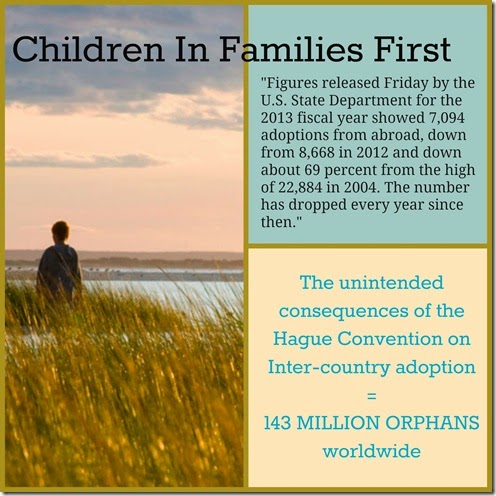
Figures released Friday by the U.S. State Department for the 2013 fiscal year showed 7,094 adoptions from abroad, down from 8,668 in 2012 and down about 69 percent from the high of 22,884 in 2004. The number has dropped every year since then.
As usual, China accounted for the most children adopted in the U.S. But its total of 2,306 was far below the peak of 7,903 in 2005.
Ethiopia was second at 993, a marked decline from 1,568 adoptions in 2012. Ethiopian authorities have been trying to place more abandoned children with relatives or foster families, and have intensified scrutiny of orphanages to ensure that children placed for adoption are not part of any improper scheme.
Russia had been No. 3 on the list in 2012, with 748 of its children adopted by Americans. But that number dropped to 250 for 2013, representing adoptions completed before Russia's ban took effect.
The ban served as retaliation for a U.S. law targeting alleged Russian human-rights violators. It also reflected resentment over the 60,000 Russian children adopted by Americans in the past two decades, about 20 of whom died from abuse, neglect or other causes while in the care of their adoptive parents.
Moving into the No. 3 spot for 2013 was Ukraine, currently engaged in political conflict with Russia. Ukraine accounted for 438 adoptions, followed by Haiti with 388, Congo with 313 and Uganda with 276.
Despite the relatively high numbers of adoptions from the Congo, that African country has been the cause of heartache from some American families trying to adopt Congolese children. In several instances, U.S. parents have obtained court approval for adoptions and taken custody of the children, only to be denied exit permits that would enable them to bring the children to the United States. They face a choice of living in the Congo with their children or returning to the U.S. without them.
"It's a terrible shame," said Susan Jacobs, the State Department's special adviser on children's issues.
Along with Russia and Ethiopia, the biggest contributor to the one-year drop was South Korea, which accounted for 627 U.S. adoptions in 2012 but only 138 last year. Jacobs said this decline was due primarily to new adoption procedures implemented by South Korea.
The last time there were fewer foreign adoptions to the U.S. was in 1992, when there were 6,472, and the downward trend has dismayed many advocates of international adoption.
Chuck Johnson, CEO of the National Council of Adoption, contended that the decline stems in part from the way the State Department has applied the Hague Convention on Inter-Country Adoption, which establishes ethical standards for international adoptions.
The U.S. entered into the agreement in 2008 with strong support from adoption advocates who hoped it would curtail fraud and corruption, and then lead to a boom in legitimate adoptions. Instead, the decrease has continued.
"The U.S. has encouraged and in some cases strong-armed impoverished countries to sign the Hague Convention and then cites their inability to comply with strict Hague standards as a reason for not doing intercountry adoption with them," Johnson said.
Johnson expressed hope that Congress would support a bill introduced with bipartisan support last year — the Children in Families First Act — that would encourage more adoptions of foreign orphans. It would create a new bureau in the State Department assigned to work with non-governmental organizations and foreign countries to minimize the number of children without families — through family preservation and reunification, kinship care, and domestic and international adoption.
Concerns about corruption, child-trafficking and baby-selling have prompted the United States to suspend adoptions from several countries in recent years, including Vietnam, Cambodia, Guatemala and Nepal.
However, Jacobs said some adoptions from Vietnam — mostly involving children with special needs — were expected to resume soon. She said a Vietnamese delegation was due in the U.S. next month to interview U.S. adoption agencies with the aim of selecting some to operate in Vietnam.
"One thing that remains constant is our support for intercountry adoptions and our determination that they are done ethically and transparently," Jacobs said. "I can't think of anything worse than for a child to be consigned to an institution when they should be with a family."
The State Department reported that 84 American children were adopted by residents of foreign countries last year — 35 of them went to Canada and 38 to the Netherlands.
State Department: http://adoption.state.gov/about—us/statistics.php
David Crary can be reached at http://twitter.com/CraryAP


