Showing posts with label adopted child. Show all posts

Monday, September 4, 2017

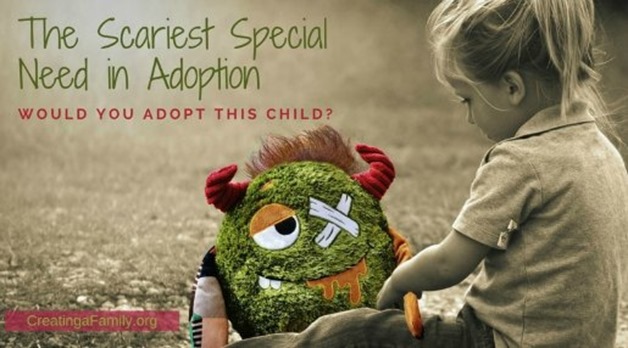
The Scariest Special Need of All—Would You Adopt This Child?

Source: https://creatingafamily.org

By Dawn Davenport


special-need-adoption-sexual-abuse

In my experience there is one special need that scares prospective adoptive parents the most. The one where even parents who have a wide range of acceptance for special needs will often say “no”. The special need that is preventing thousands of children from being adopted. That special need is being the victim of sexual abuse. Yes, that special need is actually being the victim of abuse!

Through no fault of their own these children have been sexually abused and are now being victimized again by the near universal fear of raising a child that has been sexually abused. Irony anyone?

I have been told by countless social worker that if the child has a record of sexual abuse in their file or a record of showing the symptoms of having been sexually abused, the chances of finding an adoptive family becomes infinitely harder. This breaks my heart.

Continue reading.

Friday, July 14, 2017

Building the Bonds of Attachment with Adopted Children

Source: https://creatingafamily.org

By Dawn Davenport


378130990_a0cc8dd4f4_z-1

Attachment is vital to emotional development. What can adoptive parents do to build the bonds of attachment with their adopted children? Join guest Dr. Dan Hughes, a clinical psychologist specializing in the treatment of children with attachment issues. He is the author of five books including Building the Bonds of Attachment and Attachment-Focused Parenting.

Highlights of the show
  • How much of an issue is attachment in different types of adoption (domestic, international, older child, etc.)?
  • How does the inter-uterine environment affect a child?
  • How does fetal alcohol syndrome affect attachment?
  • Tips on building attachment with young children
  • How can parents transition an adopted child to a daycare program without ruining attachment bonds?
  • How can parents help their children work through attachment issues?
  • How important is it for parents to make sure they are taking care of themselves?
  • What can parents do when they feel like they do not love their adopted child as much as their biological child?
  • How long is normal before parents feel attached to their children?
  • Why do some children have an easy attachment process and other children have a difficult attachment process?
  • Attachment issues in biological children.
  • Unevenness in attachment
  • Can attachment issues appear later in life?
  • How can parents find a good attachment councilor for their children?
  • Attachment issues with trans-racial adoptions

Click here to listen to the podcast.

Monday, April 3, 2017

Decoding Your Child's Behavior

decoding-2At some point all parents face behavioral challenges with their children. Adopted children have often had unfortunate experiences that may increase misbehavior and make traditional discipline techniques ineffective. Join Phyllis Booth, Founder of Theraplay®, and Mandy Jones, LCSW, JD, certified Theraplay® therapist at the Center for Lifelong Adoption Support, as they provide an empathetic understanding of why negative behaviors occur and discuss tools, techniques and activities that parents can use to tame temper tantrums and create positive relationships.
Topics will include:
  • Differences adopted children face in childhood and how that affects behavior
  • Behavioral and self-regulation issues both at home and in school
  • What parents can do to curb negative behaviors
  • How parents can create happy, connected family relationships
Continue reading.

Wednesday, March 15, 2017

Adoption Notice: Obtaining Citizenship or Documenting Acquired Citizenship for Adopted Children – – March 2017

5b0a1571d451438a2a82a5dfc8dfd36d

March 15, 2017

The Office of Children’s Issues has received a high number of inquiries about whether individuals adopted through the intercountry process have acquired U.S. citizenship and how to go about documenting U.S. citizenship, if acquired. Claims to acquisition of citizenship cannot be pre-adjudicated, and the Office of Children’s Issues has no role in the adjudication process. Information is available on the Department of State and U.S. Citizenship and Immigration Services (USCIS) web pages and may be helpful resources.

Continue reading.

Friday, March 25, 2016

Register Now! Anxiety and Depression in Adopted Children

Upcoming Webcast


Anxiety and Depression Webinar: Thursday, April 7 8PM Central 

REGISTER NOW

Studies show that the rate of anxiety and depression in adopted children is more than double that of the general population.

Depression, while usually associated with lethargy in adults, often looks like anger in kids. Anxiety typically sounds fearful in adults, but looks more like avoidance, annoyance or off-the-wall behavior in children.
Specific topics will include:
  • The incidence of depression and anxiety in our adopted or foster children
  • The role of early trauma and how it can play out over time
  • What depression and/or anxiety looks like at different ages and stages
  • How to help kids develop more coping tools
  • When to consider professional help


Our featured experts:


Learn more and click here to register now 

Feel free to forward this on to anyone who may benefit!

We've relaunched a portion of our website to optimize the experience for our webcasts. Let me know what you think!

Thank you,
Kirby

Questions? Email Kirby

Tuesday, March 8, 2016

“I Feel Like a Beast, but I Don’t Love My Adopted Child” by Dawn Davenport of Creating A Family

Source: www.creatingafamily.org

  cryingchild
We all expect to fall immediately in love with our adopted child, but what if this doesn't happen? Parents blame themselves and children suffer. What's a parent to do? Check out this week's blog for one woman's experience. Continue Reading.

Wednesday, March 2, 2016

Armenia: The Road Less Traveled: Best Friends' Reunion

Best Friends' Reunion

The day we met Ella in May 2014, she told us, "I have a best friend named Lilit and I want you to meet her." The next morning, we had the opportunity to do so and it was immediately obvious to us that these two girls were very close.  We knew that their friendship would likely be Ella's biggest emotional loss caused by our adoption.  By the time we picked up Ella in October 2014, Lilit had been transferred to an older child orphanage where they would probably have gone together had we not found Ella in time.

Over the next year and a half, as Ella learned English and was able to share more about her life in Armenia, she continually spoke to us of Lilit, of her love for her, her worry about her health, the day they were separated, and the experiences they had together.  Ella requested we place Lilit's picture on the wall beside her bed and even wondered if Lilit could become her sister via adoption.

Continue Reading.

Friday, January 29, 2016

What Is Adoption Medicine? (by NCFA)

Adoption Medicine: Improving the Health and Wellbeing of Adopted Children

By Dr. Emily Todd

http://barnimages.com/ First, let me answer the question on everyone’s mind: What is adoption medicine? Children who join families through adoption may have special health, behavioral, and developmental needs. Adoption medicine addresses those needs with the family in all phases of the adoption journey. Those of us in adoption medicine are typically pediatricians, but we have a variety of additional training beyond pediatrics, in areas such as genetics, infectious diseases, global health, and developmental or behavioral pediatrics. We apply our skills in all phases of the adoption journey – both before and long after an adoption to help children adopted via all types of adoption. Within the American Academy of Pediatrics (AAP), there exists the Council on Foster Care, Adoption, & Kinship Care (COFCAKC). This is a group of pediatricians with a special interest in adoption, kinship care, and foster care. These pediatricians are dedicated to improving the health and wellbeing of children and youth in foster care and kinship care, as well as those who have been placed in permanent adoptive families.

 Read more (PDF)

Friday, January 15, 2016

Show Hope is partnering with Empowered to Connect to present the Empowered to Connect Conference in Nashville, TN, and we need your help to spread the word!

ETC Nashville

Show Hope is partnering with Empowered to Connect to present the Empowered to Connect Conference in Nashville, and we need your help to spread the word!

This two-day conference will feature researchers from TCU led by and experts in the field of research-based interventions for children from hard places, led by Dr. Karyn Purvis. It will be an invaluable experience for families, churches and professionals who seek to better serve children impacted by foster care and adoption. This is also a great opportunity for families who are considering adopting or fostering.

REGISTER NOW

Cost: Early-bird registration is $45/individual OR $60/married-couple (Early-bird pricing is available through February 12).

SPECIAL OFFER TODAY ONLY: Register using the code NEWYEAR to receive 20% off your ticket.

Continuing Education Credits: The 2016 Empowered to Connect conferences will be approved by the National Association of Social Workers for Social Work continuing education contact hours. More info here. 

Parent Training certificates will be available each day as well. Attendance certificates are provided at the end of each day for parents.

If you have any questions, please email us at etcconferences@showhope.org. We hope to see you soon!

How You Can Help: Get The Word Out!

Share on Facebook Share on LinkedIn Share on Twitter Share on Google+ Share on Email

To learn more about Show Hope, please visit showhope.org.

Friday, January 8, 2016

WEBINAR: Attending to Needs, Connecting for Life: Dr. Purvis on Attachment


Thursday, February 4, 2016; 7:00 PM CT

REGISTER NOW

Join us as Dr. Karyn Purvis discusses her latest research surrounding attachment and connecting with children who have experienced a tough beginning in life.
With her naturally warm style, Dr. Purvis will share insights to help us better understand and connect with each other.

She will provide practical tips to building a foundation of love, support and security to help your family thrive.

Specific topics include:
  • Connecting principles for attachment needs
  • Techniques to connect with your child at different developmental stages
  • Correcting principles to disarm fear-based behaviors
Click here to register now 

By the way, we've launched a new portion of our website this new year. It is a special section dedicated to our webinars/webcasts. Let me know what you think!

All the best,
Kirby


Questions? Email Kirby

Wednesday, April 8, 2015

Talking With Children About Adoption

Source: https://www.adoptivefamilies.com

By Barbara Russell

Talking about adoption with your child can be daunting. Here, advice on what to say and when to say it.

talking-with-children-about-adoption

Catherine Brunson clearly remembers the day she learned she was adopted. “Someone approached my brother in school and said, ‘Oh, you’re the adopted kid,’” says Brunson, a 37-year-old graphic designer in Charlotte, NC, who is the oldest of three adopted siblings. “My brother came home and asked my mom.”

“My mom took both of us by the hand and proceeded to take us in the bedroom and tell us the facts of life,” she says. “While we stood there, she went through the whole thing — the birth process, etc. Then she segued into how this happened to someone else, not to her and Dad.”

“We were looking at each other going, ‘Wow.’”

Misguided? Comical? Potentially harmful? Perhaps, by today’s standards. Effective? Definitely, according to Brunson, who says the incident was key to helping her develop a matter-of-fact attitude about her adoption.

Read more.

Friday, January 30, 2015

Creating A Family: Attachment Podcasts for you!

attachment%2006-26-2013 Attachment is the process of of forming emotional bonds between parent and child. For healthy emotional development throughout life, the child must attach to her parents, but it is just as true that the parent has to attach to the child. Attachment is not necessarily automatic with children adopted past infancy, but attachment can be taught and learned, and there are activities and attachment parenting techniques that can help both children and parents bond.

Creating a Family has extensive resources on attachment in adoption. A few we think you will find particularly helpful are:

Thursday, November 6, 2014

$10 Webinars for National Adoption Awareness Month

DID YOU KNOW?

More than 102,000 children & youth are awaiting adoption.

To help promote National Adoption Awareness Month, each week we'll feature discounted prices on popular webinars and courses.

Check our website every Monday to see what's new, and make sure you're following us on Facebook and Twitter, where we'll share even more deals and resources.

THIS WEEK'S SPECIAL: $10 NUTRITION WEBINARS

THURSDAY, November 6, 7:00 PM CT

For This Week Only, Purchase:

Live Webinar: Healthy Eating Habits & Beyond: Strategies for Mealtime Challenges

FEATURED PRICE: $10 - Buy Now

Recorded Webinar: The Scoop on Nutrition &  the Adopted Child

FEATURED PRICE: $10 - Buy Now

Recorded Webinar: Snack, Play, Love

FEATURED PRICE: $10 - Buy Now


Questions?

Email Mandi and Shane >
Co-sponsors

Wednesday, September 3, 2014

Last Chance to Register: Tired of Timeouts Webinar

Webinar Series for Adoptive Families

TOMORROW NIGHT: Discipline and Attachment in Adoption

Thursday, September 4 - 7:00 PM CT

Tired of Timeouts: Discipline, Attachment and the Adopted Child

Traditional methods of discipline not working? Wondering how to effectively discipline your child?
Parents of adopted children - children who have experienced loss - often need to consider alternative ways to discipline their children. Focusing on attachment while disciplining your child will help correct behavior and keep a strong connection with her.

Join Dafna Lender, LCSW, Clinical Director of the Theraplay Institute, as she helps parents:

  • Understand common challenging behaviors adopted children may exhibit at each developmental stage
  • Discipline in a way that fosters learning and helps your child accept your guidance
  • Move away from rewards and threats of punishment

Friday, August 15, 2014

Why We Didn't Change Our Adopted Child's Name

"I think this can apply to all of our internationally adopted kids. We kept the names of our children incorporated into their full names. Great article and thank you Erin!"

Source: http://www.nobohnsaboutit.com/2014/08/why-we-didnt-change-our-adopted-childs-name

By Erin

valentine Whether to change an adopted child’s name is always a hot topic for adopters and adoptees. Some people are passionately for it, others passionately against it, and most somewhere in the middle. Over the years we have received many comments about our daughter’s name. Questions on how to pronounce her name… questions on how to spell her name… and before her adoption, questions on if we were going to change her name.

At this point I can’t imagine ever considering anything else. She IS Nariya. It suits her. But there was a point in the very beginning that we considered changing it.

I almost hate to say this now, but it’s the truth so here it is: I considered changing my daughter’s name because I was worried it sounded too black.

Read more.

Friday, August 1, 2014

New Webinar: Discipline and Attachment in Adoption

Discipline and Attachment in Adoption

ce55a6fc-95bc-4ee4-8913-733adcb3822e

Thursday, September 4 | 7:00 PM CT

Tired of Timeouts: Discipline, Attachment and the Adopted Child

Traditional methods of discipline are often ineffective for children who have experienced loss. Focusing on attachment while disciplining your child will help correct behavior and keep a strong connection with her. 

Join Dafna Lender, LCSW, Clinical Director of the Theraplay Institute, as she helps parents:

  • Understand common challenging behaviors adopted children may exhibit at each developmental stage
  • Discipline in a way that fosters learning and helps your child accept your guidance
  • Move away from rewards and threats of punishment

Saturday, November 16, 2013

How Stable Families Help Prevent Human Trafficking

A Good, Solid Grounding: How Stable Families Help Prevent Human Trafficking: by Natalie Tarasar, National Council for Adoption Constituent Services Intern

traffick%20stop%20now%202013%20RV I Google-imaged the word "Child"; then I Google-imaged "Adopted Child"; then I Google-imaged "Foster Child."

I figured that a quick search on Google would reflect an interesting social thought or emotion on the issue. The search for Child showed me pictures of innocence and joy; Adopted Child gave me mixed-race families and happiness; but Foster Child showed me both innocence and isolation, smiles and tears, open arms and fetal positions. Why were negative images mixed in with foster care?

Don't get me wrong; I realize that a Google search is one step below Wikipedia on information credibility, but my little social experiment got me thinking about the importance of stable families for children.

The National Council For Adoption has always and will always promote the safe, stable, and loving forever families for every child. Families provide safety, warmth, love, shelter, support, encouragement, and social interaction-things that all children deserve. Our focus on the positive, loving placement of children has been so dominant in my mind every day at work, that I was absolutely floored to learn that trafficking was so common amongst children in foster care and could even occur amongst adopted children if appropriate reviews, supports, and laws weren't available or enforced.

Keep in mind that perspective is important. Recently, the House Ways & Means, Human Resource Subcommittee held a hearing on Preventing and Addressing Sex Trafficking of Youth in Foster Care. Representative Slaughter shared there that most of the 400,000 children in the US foster care system are in loving and safe family settings. Families who have opened their hearts and homes to children who need them. Without diminishing the weight of this issue, remember that we are discussing the outliers.

Trafficking popped up again when NCFA was asked to attend the 43rd Annual Congressional Black Caucus on Modern Day Slavery: Human Trafficking in America presented by Representative Sheila Jackson. A panel of experts spoke about a system that sometimes fails to protect its dependents, though ironically its primary goal is to remove children from unsafe environments.

I was astounded by the statistics we heard there; in New York 85% of trafficked minors have either a social services or foster care background-the national number is close to 60% of trafficked youth. I wondered if it was the foster system itself that provided a segue for children to become victims of trafficking-or vice versa-if trafficked and high-risk youth were put into the foster care system. Which came first?

The answer is an unfortunate combination, which perpetuates the cycle for victims and makes this problem all the more difficult to solve. The entire premise seems to boil down to one descriptor: vulnerability.

Children's dependency makes them highly susceptible to coercion. Add to that traumatic and sometimes indefinite transitions into placement, and the vulnerability increases. At the Preventing and Addressing Sex Trafficking of Youth in Foster Care hearing, Withelma Pettigrew, a previous foster child and trafficked survivor, testified that foster children like herself have difficulty creating meaningful and positive relationships, become accustomed to isolation, and are often not involved in making their own life decisions (location, social workers, schools, activities, friends etc.) A perpetual state of mental and physical transition like this only heightens their vulnerability to manipulative and dangerous exploiters. The foster care system can make it seem normal and acceptable that their lives be unstable and they may accept the dangers of trafficking as one more hard transition - making them far too easy a target. Congressman Paulsen quoted the Chicago Tribune; "Because many girls in foster care feel starved for a sense of family, experts say it is not uncommon for pimps to target group homes."

We're grateful that many dedicated professionals-representatives, judges, lawyers, social workers, agencies, advocates, and others-work tirelessly to reduce the correlation between foster care and human trafficking. Every effort should be made to keep children safe while in foster care, this is essential. We think it's our job at NCFA to remember to also emphasize that these are important, but only interim solutions.

Family is the forever solution. A loving, stable, permanent family and support system are the best protection and the best preventative measure to keep children out of particularly vulnerable environments. NCFA advocates for providing services so that families can be kept together whenever appropriately possible; it supports the reunification of children to their previous families; and of course our work focuses on creating families through adoption when appropriate. We think it's important to review, educate, prepare, and support families to ensure that every child not only has a family, but thrives there. We believe that a permanent, nurturing forever family is the best solution and we don't ever want to lose sight of that.
Sunday, October 13, 2013

Where Is My Child's Social Security Card?????

photo The following question was posed on behalf of Hopscotch, by National Council for Adoption's, Constituent Services, Wayne Allgaier, during the August 26th Department Of State's Quarterly Stakeholders' Meeting. We greatly appreciate NCFA's willingness to bring matters to our DOS that would otherwise have remained unanswered. 

Hopscotch asked: "The DS-230 form has a section (43) on page 4 that allows the parents to request a social security card on behalf of their adopted child and it clearly states that the card will be subsequently mailed to them by checking 'yes'. All of our families, for years, have checked the 'yes' and none have ever received the cards without having to personally visit the social security office and presenting documentation (which varies office to office) to obtain the card. Most families wait many months assuming the card is just taking time to process, but ultimately it never comes. We have inquired with each consul section of all the programs we work with and have never had a response. Are you able to see if this is a defunct section that has mistakenly been left on the form or alert the departments involved that there is a disconnect?"

DOS Response: "We appreciate the feedback from adopting parents regarding the visa application form. According to the Social Security Administration, parents must initiate the process of obtaining a Social Security Card for their child by answering yes to the related question on the DS-230 or DS-260 form. (Note: The DS-260 is the fully integrated online electronic visa application form for immigrant visas. This form replaces the DS-230.) Please visit the Social Security Administration website for more information. We regret to learn that many parents do not receive their Social Security card after being admitted to the United States with their adopted children. We will contact the Social Security Administration to alert the agency."

Tuesday, October 1, 2013

Children of Trauma: What Educators Need to Know

Worthy and reposted from the Adoption Advocate No. 63

147123 Many adopted children and children in foster care have experienced traumatic events which can impact their development and present challenges for both parents and educators. In the September 2013 issue of NCFA's Adoption Advocate, author Kathleen Benckendorf outlines information, methods, and strategies that can help teachers and school officials better understand and meet the needs of children with histories of trauma, abuse, or neglect.
Click here to view, print, or download.

Has your school sufficiently addressed your child's specific needs related to adoption trauma?  What are some creative ways great teachers have supported your child?
-
Robin E. Sizemore, Executive Director of Hopscotch Adoptions, Inc