Thursday, January 21, 2016

Parents Speak Out a Year After Dad ‘Chose’ Son With Down Syndrome Over Wife

A year ago Samuel Forrest’s life abruptly changed forever. In the span of just a few days he gained a son, began divorce proceedings with his wife and found himself the focus of a lot of media attention.


(Photo: Samuel Forrest)

Now, a year later, Forrest and his wife have reconciled.

Leo Forrest was born with Down syndrome on January 21, 2015 in Yerevan, Armenia. After he was diagnosed, his mother, Ruzan Forrest, gave his dad, Samuel Forrest, an ultimatum: if he decided to keep the baby, she’d file for divorce.

Samuel Forrest decided not to have Leo placed for adoption.

“They took me in to see him and I looked at this guy and I said, he’s beautiful, he’s perfect,” Forrest told ABC News last year. “I’m absolutely keeping him.”

Forrest decided he and Leo would move back to Auckland, New Zealand, where he is from, and his wife remained in Armenia and began divorce proceedings.

Read more.

Sunday, January 17, 2016

Source: https://creatingafamily.org
By Dawn Davenport


Parenthood is stressful. We love the little darlings, but they can put a major strain on the marriage. This is especially true if our child has special challenges from being exposed to alcohol or drugs during pregnancy or was adopted at an older age and carries the baggage of abuse and neglect. What’s the trick to staying happily married when adopting or fostering children from hard places.

An all too typical pattern in adoption (and in marriage in general) is for one parent to take the lead in becoming educated about adoption, the challenges, and the type of parenting these children respond to best. Often this same parent has been the “pusher” or “moving force” behind the adoption. Often this parent is the mother. This doesn’t bode well when the challenges of adopting or fostering hit.

It’s not helpful at this point to say that the non-educated, non-pusher parent (usually the father) needs to have been educated and supported before you reach this point. That ship has already sailed. So what to do when you feel your marriage fraying under the pressure of adopting or fostering a child that has experienced trauma?

I asked this question to Dr. Karyn Purvis, author of The Connected Child, and the founder and Director of the TCU Institute of Child Development on a Creating a Family Radio show about Raising and Healing Abused and Neglected Kids. In typical Dr. Purvis fashion she had some very specific and practical advice, with a few comments of my own thrown in for good measure.

Tips For Staying Happily Married When Adopting/Fostering

  1. Make time for each other. It is crucial to nurture your marriage while parenting. Nurturance takes time and it takes intention. You must schedule time to be with your spouse as a spouse, rather than as a parent discussing the kids, the house, life’s problems. I believe a weekly “Date Night” may just have saved my marriage. It doesn’t have to be at night and it doesn’t have to cost money, but it does have to happen. Find time to do an activity you both enjoy and make a point to schedule time to do it on a regular basis. Dr. Purvis suggested taking a walk together regularly. Bottom line: find a way to have fun together again.

  2. Model what works. Rather than telling your partner how to do things, show him. If it works to improve your child’s behavior and lower his anxiety, your spouse will see it. Sometimes our words get in the way.

  3. Who should educate? You do have to talk about the kids, but often the not-as-involved parent feels ambushed by these conversations which are full of what needs to be done or how he isn’t doing things right. Is it possible that someone other than you would be better at helping to educate your spouse? Would he attend your child’s therapy session and hear from the therapist what works best? Would he listen to the many Creating a Family radio show/podcasts on parenting children who have been abused and neglected during his commute to work or while he works out?

  4. Double up on self-care. Parenting is hard work, and worrying about your marriage is even harder. You are under a lot of stress and stress makes many (all?) of us difficult to live with. You owe it to yourself and to your marriage to take care of yourself. What you need is individual to you, but for most of us includes regular exercise, enough sleep, and something to look forward to each day—a good book and time to read, a trip to Starbucks by yourself, an occasional massage, a small tub of Ben & Jerry’s Cherry Garcia, or a night out with your friends.

  5. Show some compassion. The biology of most mothers leads them to want to nurture their children and figure out how to meet their children’s needs. The biology of most fathers leads them to want to protect their family. The continual chaos that can happen when adopting or fostering a child who is struggling with the aftermath of abuse and neglect makes many dads feel powerless. Powerless is a lousy place to be, and many fathers just give up. Understanding the reasons why, goes a long way to lowering your frustration. [I struggled with the gender stereotyping in this piece of Dr. Purvis’s advice, but I have to admit that it rings true.]

Friday, January 15, 2016

Show Hope is partnering with Empowered to Connect to present the Empowered to Connect Conference in Nashville, TN, and we need your help to spread the word!

ETC Nashville

Show Hope is partnering with Empowered to Connect to present the Empowered to Connect Conference in Nashville, and we need your help to spread the word!

This two-day conference will feature researchers from TCU led by and experts in the field of research-based interventions for children from hard places, led by Dr. Karyn Purvis. It will be an invaluable experience for families, churches and professionals who seek to better serve children impacted by foster care and adoption. This is also a great opportunity for families who are considering adopting or fostering.

REGISTER NOW

Cost: Early-bird registration is $45/individual OR $60/married-couple (Early-bird pricing is available through February 12).

SPECIAL OFFER TODAY ONLY: Register using the code NEWYEAR to receive 20% off your ticket.

Continuing Education Credits: The 2016 Empowered to Connect conferences will be approved by the National Association of Social Workers for Social Work continuing education contact hours. More info here. 

Parent Training certificates will be available each day as well. Attendance certificates are provided at the end of each day for parents.

If you have any questions, please email us at etcconferences@showhope.org. We hope to see you soon!

How You Can Help: Get The Word Out!

Share on Facebook Share on LinkedIn Share on Twitter Share on Google+ Share on Email

To learn more about Show Hope, please visit showhope.org.

Friday, January 8, 2016

WEBINAR: Attending to Needs, Connecting for Life: Dr. Purvis on Attachment


Thursday, February 4, 2016; 7:00 PM CT

REGISTER NOW

Join us as Dr. Karyn Purvis discusses her latest research surrounding attachment and connecting with children who have experienced a tough beginning in life.
With her naturally warm style, Dr. Purvis will share insights to help us better understand and connect with each other.

She will provide practical tips to building a foundation of love, support and security to help your family thrive.

Specific topics include:
  • Connecting principles for attachment needs
  • Techniques to connect with your child at different developmental stages
  • Correcting principles to disarm fear-based behaviors
Click here to register now 

By the way, we've launched a new portion of our website this new year. It is a special section dedicated to our webinars/webcasts. Let me know what you think!

All the best,
Kirby


Questions? Email Kirby

Thursday, January 7, 2016

Merry Christmas from Serbia!

Serbian Christmas (Badnje Vece) Recipes

By Barbara Rolek

Most Serbians are Orthodox Christians who follow the Julian calendar. Thus, Christmas Eve is celebrated on Jan. 6 and Christmas on Jan. 7. In the old days, on Christmas Eve morning, Serbian fathers would take their eldest son to chop down (or in more recent times, buy) a young oak tree called a badnjak. There is a festive badnjak burning at night and then a meatless meal which varies from family to family. Typically, wheat grass, that was planted on St. Nicholas Day, symbolizing a good harvest, and cesnica, which isn't eaten until Christmas morning, are on the table.

Read more about how Serbians Celebrate Christmas.

Merry Christmas from Georgia!

Unique Traditions For New Year And Christmas In Georgia

By Kidworldcitizen

The traditional Georgian Christmas tree, called chichilaki in Georgian, is not green. Georgians have been making the Georgian-style Christmas tree since ancient times. Environmentally friendly Chichilaki originated in the provinces of Guria and Samegrelo, the western part of the country.Chichilaki was decorated with the two bow-shaped items called Kalpi and Bokeri. Kalpi was made from ivy leafs and Bokeli was a bread baked with eggs, flour, and cheese both as the symbols of life and fertility.

At first sight, nutwood twigs with long fluffy shavings may seem quite unattractive if you are used to lush green, fir-tree branches. The curly shavings, which the master removes moving upwards from the bottom, are called basila in honor of St. Basily’s beard, the patron saint of animals and harbinger of new happiness. A wooden cross is usually attached to the top of the chichilaki and the tree itself is invariably decorated elegantly with fruits, berries and flowers. Unfortunately, this beauty doesn’t stay long: after the holidays, people burn their trees, symbolizing that the previous year’s misfortunes go up in smoke.

More familiar Christmas concepts have a place in Georgian festivities, as well. Santa Claus, known as tovlis bubua (Grandpa Snow), is usually depicted wearing traditional Georgian clothes and a fur cloak called a nabadi. Although Grandpa Snow doesn’t have reindeer, but he still is believed to visit homes on Christmas Eve, leaving presents for the children.

Mekvele is another typically Georgian New Year’s tradition.  The first person to come into one’s house on New Year’s with “happy feet’ symbolically brings in joy and prosperity. He or she is showered with candies and in return presents the hosts a basket with delicacies wishing the upcoming year to be satisfying and sweet.  Those said to have “happy feet” are invited to Georgian households to provide good luck for the family.

Merry Christmas from Ukraine!

Sunday, January 3, 2016

A New Year And Still They Wait. Let’s Change This Together.

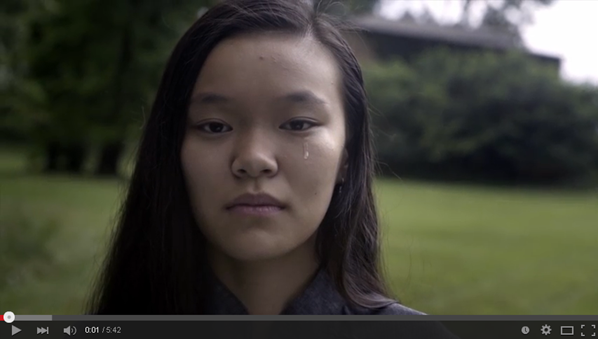
f o u N d – an adoption story

"f o u N d" is a moving video spreading awareness for international adoption and the need for specialized medical care. These are real stories told by the actual children. ‪#‎found‬‪ #‎family‬ ‪#‎adoption‬ #love

Like Found: An Adoption Story on Facebook.

See video.

bcccfb81bf47effa2e1c25e01f2f7f74