Showing posts with label Children in Families First. Show all posts

Tuesday, June 24, 2014

CHIFF Momentum is Growing... Watch This Video!

The momentum is building for CHIFF! In the last 24 hours, over 1,500 people have signed the petition and hundreds more have 'Liked' CHIFF on Facebook. Let’s keep sharing the petition and the need for this life changing bill.

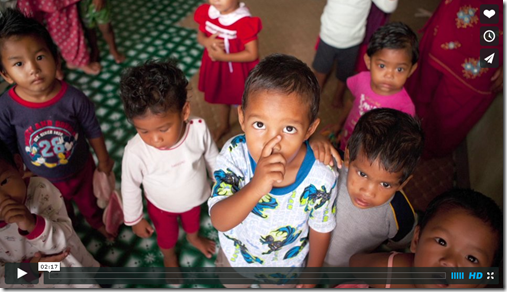
Below is a video explaining CHIFF. Feel free to share it as you continue to share with your contacts throughout the week. Together, we can make a huge impact!

Let's keep the momentum going! Keep spreading the word about CHIFF and together we can change the future for children who need our help.

Click here to see video.

fb928f0b83dcffc3a69052ccf72fb1ca

Thursday, May 22, 2014

Listen Up! UAA Webinar Recording from May 20, 2014

Here is the link to the recording of the May 20th CHIFF webinar.  https://www1.gotomeeting.com/register/853896601

Please note that when you click on the link, you will be prompted to enter your email address.

Please feel free to distribute the link to your staff, constituents, families, etc.

uaa%20recording%20with%20flags%202014

Friday, March 21, 2014

Foreign Adoptions by Americans Decline Sharply

NEW YORK March 21, 2014 (AP)

By DAVID CRARY AP National Writer
Children%20in%20Families%20First%202014

The number of foreign children adopted by U.S. parents plunged by 18 percent last year to the lowest level since 1992, due in part to Russia's ban on adoptions by Americans. Adoptions from South Korea and Ethiopia also dropped sharply.

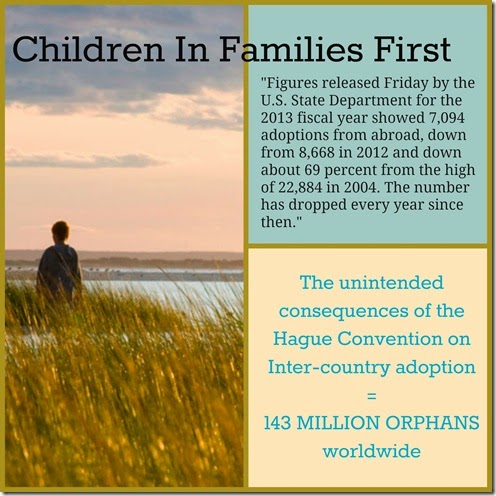
Figures released Friday by the U.S. State Department for the 2013 fiscal year showed 7,094 adoptions from abroad, down from 8,668 in 2012 and down about 69 percent from the high of 22,884 in 2004. The number has dropped every year since then.

As usual, China accounted for the most children adopted in the U.S. But its total of 2,306 was far below the peak of 7,903 in 2005.

Ethiopia was second at 993, a marked decline from 1,568 adoptions in 2012. Ethiopian authorities have been trying to place more abandoned children with relatives or foster families, and have intensified scrutiny of orphanages to ensure that children placed for adoption are not part of any improper scheme.

Russia had been No. 3 on the list in 2012, with 748 of its children adopted by Americans. But that number dropped to 250 for 2013, representing adoptions completed before Russia's ban took effect.

The ban served as retaliation for a U.S. law targeting alleged Russian human-rights violators. It also reflected resentment over the 60,000 Russian children adopted by Americans in the past two decades, about 20 of whom died from abuse, neglect or other causes while in the care of their adoptive parents.

Moving into the No. 3 spot for 2013 was Ukraine, currently engaged in political conflict with Russia. Ukraine accounted for 438 adoptions, followed by Haiti with 388, Congo with 313 and Uganda with 276.

Despite the relatively high numbers of adoptions from the Congo, that African country has been the cause of heartache from some American families trying to adopt Congolese children. In several instances, U.S. parents have obtained court approval for adoptions and taken custody of the children, only to be denied exit permits that would enable them to bring the children to the United States. They face a choice of living in the Congo with their children or returning to the U.S. without them.

"It's a terrible shame," said Susan Jacobs, the State Department's special adviser on children's issues.

Along with Russia and Ethiopia, the biggest contributor to the one-year drop was South Korea, which accounted for 627 U.S. adoptions in 2012 but only 138 last year. Jacobs said this decline was due primarily to new adoption procedures implemented by South Korea.

The last time there were fewer foreign adoptions to the U.S. was in 1992, when there were 6,472, and the downward trend has dismayed many advocates of international adoption.

Chuck Johnson, CEO of the National Council of Adoption, contended that the decline stems in part from the way the State Department has applied the Hague Convention on Inter-Country Adoption, which establishes ethical standards for international adoptions.

The U.S. entered into the agreement in 2008 with strong support from adoption advocates who hoped it would curtail fraud and corruption, and then lead to a boom in legitimate adoptions. Instead, the decrease has continued.

"The U.S. has encouraged and in some cases strong-armed impoverished countries to sign the Hague Convention and then cites their inability to comply with strict Hague standards as a reason for not doing intercountry adoption with them," Johnson said.

Johnson expressed hope that Congress would support a bill introduced with bipartisan support last year — the Children in Families First Act — that would encourage more adoptions of foreign orphans. It would create a new bureau in the State Department assigned to work with non-governmental organizations and foreign countries to minimize the number of children without families — through family preservation and reunification, kinship care, and domestic and international adoption.

Concerns about corruption, child-trafficking and baby-selling have prompted the United States to suspend adoptions from several countries in recent years, including Vietnam, Cambodia, Guatemala and Nepal.

However, Jacobs said some adoptions from Vietnam — mostly involving children with special needs — were expected to resume soon. She said a Vietnamese delegation was due in the U.S. next month to interview U.S. adoption agencies with the aim of selecting some to operate in Vietnam.

"One thing that remains constant is our support for intercountry adoptions and our determination that they are done ethically and transparently," Jacobs said. "I can't think of anything worse than for a child to be consigned to an institution when they should be with a family."

The State Department reported that 84 American children were adopted by residents of foreign countries last year — 35 of them went to Canada and 38 to the Netherlands.

State Department: http://adoption.state.gov/about—us/statistics.php

David Crary can be reached at http://twitter.com/CraryAP
Friday, December 20, 2013

Request of Secretary Kerry to Personally Intervene

voices%20of%20child%20chiff%2012-19-2013 The Children in Families First Working Group Claims U.S. Department of State Arbitrarily Limits International Adoptions Request Secretary Kerry to personally intervene.

WASHINGTON, D.C. - December 19, 2013 - The "Children in Families Working Group," a coalition of nonprofit advocacy organizations seeking change in global policies for children living outside of family care, asked Secretary of State John Kerry to conduct a thorough internal review of U.S. Department of State policies that prohibit orphaned children from certain countries from benefitting from international adoption.

According to a letter sent to the Secretary and signed by nine organizations, the group has concerns with recent actions taken by Office of Children's Issues to block other countries from re-opening their international adoption programs, stating that as a whole, these decisions appear arbitrary and inconsistent. Since U.S. implementation of The Hague Convention on Inter-country Adoption in 2008, no U.S. adoptions have occurred from the 13 countries that have become Hague Convention partners. By contrast, in 2004 alone, more than 4,100 children were adopted into US families from these same countries.

Cambodia was cited as a specific example of the types of harms that occur because of these policies, noting that since international adoptions ceased in 2001, tens of thousands of Cambodian children have languished in orphanages, with many of those who "age out" ending up dead, on the streets or trafficked into the sex trade. The Department of State has recently indicated that it will oppose the re-opening of adoptions to the United States until Cambodia has an effective domestic adoption system in place. Elizabeth Bartholet, Professor of Law and Director of the Child Advocacy Program at Harvard Law School, commented, "It's vitally important that the Department of State shift gears. It needs to honor rather than trample child human rights, it needs to help kids get the loving homes they need, rather than lock kids into life-destroying institutions."

Craig Juntunen, founder of Both Ends Burning stated "Despite the fact that families all over this country are hoping to adopt children, International adoption to the U.S. has declined dramatically, from nearly 23,000 children in 2004 to less than 9,000 in 2012. Unless action is taken that decline will continue. More than 60,000 children would be growing up in the love and care of a family today if adoptions had remained stable at the rate it was in 2004. Instead these children are living compromised lives in orphanages. Scientific research has documented the harm that occurs to children in these circumstances. Their mental and physical development is permanently impacted. We are hopeful that Secretary Kerry will take action to re-establish connections with countries whose children are in dire need."

Kathleen Strottman, Executive Director of the Congressional Coalition on Adoption Institute, who took part in a Congressional delegation visit to Cambodia this past February, commented "What is the most frustrating about decisions like the one recently made in Cambodia is that the Government of Cambodia has made significant progress in preventing the abandonment of children and promoting domestic adoption but these advancements don't ever seem to be enough."

The full text of the letter to Secretary Kerry is available here.

Signing organizations include:
American Academy of Adoption Attorneys
Both Ends Burning
Center for Adoption Policy
Congressional Coalition on Adoption Institute
Harvard Law School Child Advocacy Program
Joint Council for International Children's Services
Kidsave
National Council For Adoption
Saddleback Church Orphan Care Initiative

Monday, October 7, 2013

The Safest Place for a Child is in the Loving Arms of a Parent

Children without a family are at higher risk for trafficking, forced labor and abuse.

562b83ac8b689dbe63a927c92477f525

Food and Shelter Do Not Help Children Grow, Parents Do!

84e8a14e54f712cf086e9314d3486260

Millions of children are stuck and forgotten, living in orphanages

5d4af1ca9440cc99ba5e790665236ea3

House & Senate: What It's Going To Take To Get Kids In Families

29d9545fd6aabe651b22f0f0d0bb117f

Children Need Families & We Need Your Voice

CTAbtmHome4

Children without parents are the most vulnerable children in the world. They are alone, they are often out of sight, and they are voiceless. They cannot fight for themselves; they need YOU to be their voice. CHIFF Children in Families First calls for the redirection of a modest portion of the $2 billion the United States currently spends on children living abroad toward ensuring that all children grow up in a family. What’s more, it calls for programs funded with US tax dollars to focus on reducing the number of children living without families and increasing the capacity of other governments to better protect their own children. The best protection for a child is a family. We protect children by preserving families, reunifying families or creating families through adoption.

Sunday, September 29, 2013

Children In Families FIRST!!

c39b587c4506456643a6daab36b32809 

526af2ed09dc5f88c034f5782d97b83f

It’s Day 5 of CHIFF Week!

Each day this week I’ve been sending you a note with one thing you can do that day to support CHIFF.  Here’s what you can do today – Day 5 of CHIFF Week.

CONTACT YOUR MEMBERS OF CONGRESS TODAY

60ef9049574fda3c72969ae680d676c8 Call Your Members of Congress

Surveys show that only 20 calls from constituents are needed for a bill to get the attention of our elected officials.  So if you only do one thing, please call.  Here is a sample script you can personalize for making that call! 

.

902c73ca3f1115c519912a76e3339585 Double Up - Email A Letter to Congress

Tell your Members of Congress you want them to support the Children in Families

First Act of 2013!  Here’s a template letter but be sure to personalize it.

Thanks for being a Joint Council Partner and for helping us make a historic change in the way the US government serves children and families.

Best Wishes,

Tom DiFilipo

P.S.  If you didn’t see Day 1 through 4 click here to find out what you missed – it’s not too late to catch up!

|    website   |    adoption nutrition |     facebook     |       blog       |     twitter   |    donate   | 


   |   TOM DIFILIPO |   President & CEO  |   Joint Council   |  +1.703.535.8045  |       

CHIFF Week

Day 1 – Register for the CHIFF Webinar.  If you missed it, click here for a recorded version.

Day 2 -  Become a CHIFF Sponsoring Organization.  Send an email to    

info@childreninfamiliesfirst.org stating “NAME OF ORGANIZATION is a CHIFF Sponsoring

Organization.  

Day 3 – Like CHIFF’s Facebook page and post about CHIFF on yours.

Day 4 – Send out a Call To Action and rally your troops.

Day 5 -  Call your Members of Congress!

Friday, September 20, 2013

Children in Families First

Winter%202008-09%20212

The Children in Families First working group is looking for child or family stories to highlight on the website. If you know of families whose stories clearly show the need for intercountry adoption reform and would be willing to briefly share their story and a photo please let me know. For examples of how the stories would be used click here to see the stories of Addison and Jean. You may contact me or put them in contact with me directly at mlindsey@adoptioncouncil.org or by phone at 703-299-6633.

Families are also welcome to share their stories directly on the CHIFF website at Add Your Story. Feel free to encourage your networks to share their stories there and to like Children in Families First on Facebook.

Megan Lindsey
Director of Public Policy and Education
National Council For Adoption
225 N. Washington Street
Alexandria, VA 22314
T: 703.299.6633 | F: 703.299.6004
mlindsey@adoptioncouncil.org
www.adoptioncouncil.org