Sunday, April 10, 2016

Nappies For Nork 2016 - Your Change to Make a "Change" in Armenia!

Source: http://martiniadoptionroad.blogspot.com

Nappies For Nork 2016


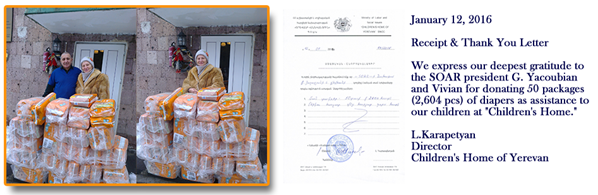
Last year, through the great generosity of many donors, we raised $12,000 for SOAR to purchase diapers for Nork orphanage in Yerevan.  For eleven months, thousands of diapers were delivered to the children living there, but the funds will run out after the final delivery this month.

Therefore, please join us in Nappies For Nork 2016, a collaboration of SOAR, Hopscotch Adoptions, and adoptive mom Viviane Martini whose son lived at Nork from early 2009 until summer 2011.

Learn more.

6fa7035da4e22475098189b958ad6723

Friday, April 8, 2016

Nappies For Nork!


Last year, through the great generosity of many donors, we raised $12,000 for SOAR to purchase diapers for Nork orphanage in Yerevan.

For eleven months, thousands of diapers were delivered to the children living there, but the funds will run out after the final delivery this month.

Therefore, please join us in Nappies For Nork 2016, a collaboration of SOAR, Hopscotch Adoptions, and adoptive mom Viviane Martini whose son lived at Nork from early 2009 until summer 2011.

Please send your tax-deductible donation by check to:

Society for Orphaned Armenian Relief
ATTN: George S. Yacoubian, Jr.
150 N. Radnor Chester Rd.
Suite F-200
Radnor, PA 19087
USA

Or via Paypal on the SOAR website: http://soar-us.org/donate.html#donation.

Please earmark your donation for the 2016 Nappies for Nork diaper fund.

Read the whole story and get information on the raffle here!

Thursday, April 7, 2016

UNICEF Fostering Success Comes With A Price: Pemanency Denied to Unparented Children

Source: http://www.unicef.org

Deinstitucionalizacija-01_-_380 Having seen great foster care provided to children in Serbia, I can personally attest to how great this is for kids… EXCEPT…. UNICEF holds solidly to the goal for every unparented child is to have a “family environment” rather than making permanency planning the end goal for every child – a forever family – not just a family “environment”.

Read more.

Multiple Citizenship in Adoption: An Introduction by NCFA's legal fellow Kaylee Walsh

Map%20travel%20airplane%20world

Those working in adoption often face questions about dual or multiple citizenship from prospective adoptive parents and adopted adolescents and adults, who want to know how the internationally adopted person will attain U.S. citizenship, if they will have two passports, or if being a citizen of their birth country will affect their U.S. citizenship. This article by NCFA legal fellow Kaylee Walsh provides an introduction to these and other issues regarding multi-citizenship in intercountry adoption. 

Click here to download the PDF of Adoption Advocate No. 94 or click here to view the web version.

Tuesday, April 5, 2016

May Webcast: Raising Black Boys - A Panel Discussion

Raising Black Boys - A Panel Discussion


May 5, 2016 | 8:00 PM Central

Raising Black Boys Webinar: Thursday, May 5 8PM Central

REGISTER NOW

Raising Black Boys is an honest dialogue about some of the tough realities and complex issues that Black children may experience and how their parents can guide, support and prepare them for a society that is far from color blind.

Join us for a moderated panel featuring African American men from all over the country and from varied backgrounds. Some were transracially placed as young children. All are distinguished in their respective fields.

They will reflect back to their childhood as well as their current role as fathers of Black boys. They will share openly and honestly about the types of discussions that are taking place in their own homes, as well as the everyday fears they have about their sons’ safety and how they are raising them to become strong Black men. We will pose to the panelists the concerns we have heard from adoptive families who are raising Black boys.

Concerns such as:
  • How to have a conversation about racism without hurting a child's self-esteem
  • How to protect young Black boys from the hurt that stereotypes and exclusion can bring
  • How to address and confront the insidious forms of racism transracially formed adoptive families of Black boys are now aware of since adopting their child
Click here to learn more and register
 
Feel free to forward this on to anyone who may benefit!

Our Children Initiative

This webcast is brought to you by ALP in cooperation with Our Children: An Education & Empowerment Series. Learn more about the Our Children Initiative here.

Questions? Email Kirby

Sunday, April 3, 2016

Intercountry Adoptions by Americans Lowest Since 1981

FOR IMMEDIATE RELEASE
Media Contact:                                                
Chuck Johnson
(703) 299-6633
cjohnson@adoptioncouncil.org

Intercountry Adoptions by Americans Lowest Since 1981

Sad_Depressed_Lonely_Rain_List April 1, 2016 – Alexandria, VA – The U.S. Department of State has released its FY 2015 Annual Report on Intercountry Adoption, revealing that American families adopted 5,648 foreign-born children in 2015. This marks a 12% decline from the 6,441 foreign-born children adopted the previous year and a 75% decline since intercountry adoptions reached a peak in 2004, when 22,991 foreign-born children were adopted. This is the lowest number of intercountry adoptions since 1981.

National Council For Adoption (NCFA), a non-profit organization committed to adoption advocacy, awareness, and education efforts, notes that this continued decline in intercountry adoptions has a tragic impact on the growing number of orphaned and abandoned children who desperately need a family.

“We would welcome a world in which all children everywhere received loving and permanent care from their biological families or from extended family or adoptive families in their birth countries,” says NCFA president and CEO Chuck Johnson. “The reality is that the world’s orphan population is growing by the millions and that many of these children will not be reunited with family members or placed with relatives or domestic adoptive families. Instead, they are left homeless or living in orphanages or institutions, which are often under-funded, under-staffed, and don’t provide the one-on-one care children need in order to thrive. For thousands of children, intercountry adoption will be their only opportunity to live, learn, grow, and thrive within a family, and be protected from trafficking, forced into the sex trade, homelessness, or premature death.”

There are several factors that contributed to the decline in intercountry adoptions. Some of the multi-year decline can be attributed to Russia and Guatemala closing intercountry adoptions to the United States in recent years and, specifically, fewer adoptions from Ethiopia, Haiti, and Ukraine in 2015.

“It’s a vicious and dangerous cycle,” says Johnson. “Developing nations have large orphan populations and intercountry adoption is a viable solution for some of them. Yet, intercountry adoption is not allowed because the developing nation doesn’t have an advanced child welfare system or an ability to offer other solutions like family preservation services or domestic adoption or they can’t provide the level of oversight to the adoption process deemed necessary by the United States.”

Many child welfare leaders and scholars from around the world are committed to improving the care their countries provide for orphaned or abandoned children within their own borders. NCFA has worked in concert in the last year with leaders from China, Colombia, Hong Kong, and Ukraine amongst others to share ideas about in-country options like family preservation, foster care, and domestic adoption processes and support.  There is a great opportunity and need for all nations to learn from one another and support one another in our common goal of finding solutions for children living outside of family-based care.

In the United States, the federal government can play a key role in reversing the trend of declining adoptions by working collaboratively with the adoption community to find solutions; seeking country-specific solutions that will open doors of opportunity for orphaned or abandoned children to be adopted; and providing technical assistance to countries who want to engage in intercountry adoption, but need support to put appropriate oversight in place. In recent months, NCFA has been grateful to see meaningful improvements from Department of State’s Office of Children’s Issues in communication, openness to consider country-specific solutions, and willingness to provide support to sending countries, adoption service providers, and adopting families. Still, we think there is much work to be done to provide the appropriate support to ensure more children find their way to willing, waiting families.  National Council For Adoption continues to call on Congress to provide more mission-specific direction to the Department of State and more clearly define their responsibilities as the United States’ Central Adoption Authority to ensure that this new approach is long-lasting and continues to improve. Ultimately, we at NCFA believe that recent changes in practice paired with additional mission-specific directives will result in the U.S.’s ability to serve more children through intercountry adoption, while also ensuring legal, ethical, and transparent practices.

Lastly, Mr. Johnson expressed, “I am hopeful that this is the last year that I am asked to comment on the decline, but, instead, be able to celebrate next year with the Child Welfare community the increase in the number of children who find loving families through intercountry adoption.”

Click here to view the FY2015 Annual Report on Intercountry Adoption and the accompanying narrative.
# # #

ABOUT NATIONAL COUNCIL FOR ADOPTION

Founded in 1980, National Council For Adoption (NCFA) is a global adoption advocacy nonprofit that promotes a culture of adoption through education, research, legislative action, and collaboration. As the authoritative voice for adoption, NCFA’s areas of focus include domestic infant adoption, adoption and permanency outcomes for youth in foster care, and intercountry adoption. Passionately committed to the belief that every child deserves to thrive in a nurturing, permanent family, NCFA serves children, birth parents, adopted individuals, adoptive families, and adoption professionals. In addition, we work tirelessly to educate U.S. and foreign government officials and policymakers, members of the media, and all those in the general public with an interest in adoption.

For more information, visit www.AdoptionCouncil.org.
Post-Adoption Services: Acknowledging and Dealing with Loss by Nancy Randall, Psy.D. and Kim Shepardson Watson, LCSW

Source: http://www.adoptioncouncil.org

teen%20girl%20lonely%20forest%202016 “Some imagine that life for the newly adopted child will now unfold in typical “fairy tale” fashion, since the happy ending – a loving family – has been found. But what about the other side of adoption – the side that can often involve complicated feelings of loss and grief and, sometimes, lifelong unanswered questions? Losses are inherent in adoption….”

Read more.

Saturday, April 2, 2016

Parenting After Trauma: Understanding Your Child’s Needs by the American Academy of Pediatrician

This guide for families explains how trauma can impact a child and provides tips for making them feel safe in their new home. Pediatricians can reproduce and provide this handout to foster and adoptive parents.

Download Guide (PDF)

Helping Foster and Adoptive Families Cope With Trauma: A Guide for Pediatricians by the American Academy of Pediatricians

The purpose of this guide is to support adoptive and foster families by strengthening the abilities of pediatricians to:
  • identify traumatized children, educate families about toxic stress and the possible biological, behavioral, and social manifestations of early childhood trauma, and
  • empower families to respond to their child’s behavior in a manner that acknowledges past trauma but promotes the learning of new, more adaptive reactions to stress.
Download Guide (PDF)